
CATV / RF Over Fiber
Common Optical Equipment used to Transmit and Receive CATV or DATA over Fiber Optic Cables. Includes Items such as Nodes, ONU’s, PON Muxes and Filters, Mini-Nodes, RFoG nodes, Return Path receivers. Solutions for Fiber to the Home, MDU, Business, Curb, Hub.

Return Path Transmitter 5~204 MHz RF over Fiber
The MX-TR1x10-R5-204 is a one way return path optical transmitter. Primarily used to transmit return RF signals (5~204MHz) over fiber.
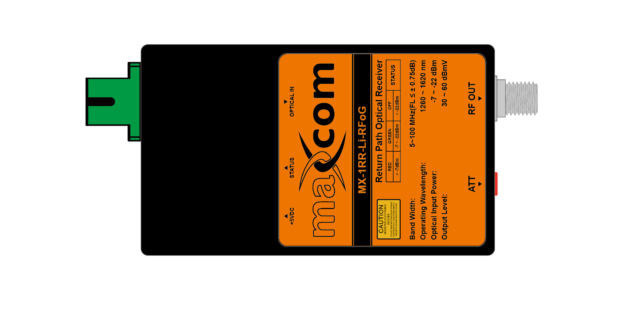
Mini Fiber Optic Return Path Receiver
The MX 1RR-LI transforms return optical signals to RF signal. The standard mini receiver module can receive return optical signals from burst mode mini-nodes or RFoG optical network units (ONU)-Mini-Nodes.
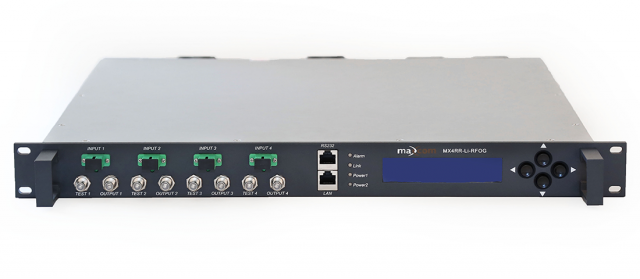
4 or 8 Way Fiber Optic Return Path Receiver (low optical input)
The MX RR-LI transforms return optical signals to RF signal output. The standard 1U chassis integrates 4 or 8 independent receiver modules, it can receive up to 256 return optical signals from burst mode mini-nodes or services for 256 RFoG optical network units (ONU)-Mini-Nodes.
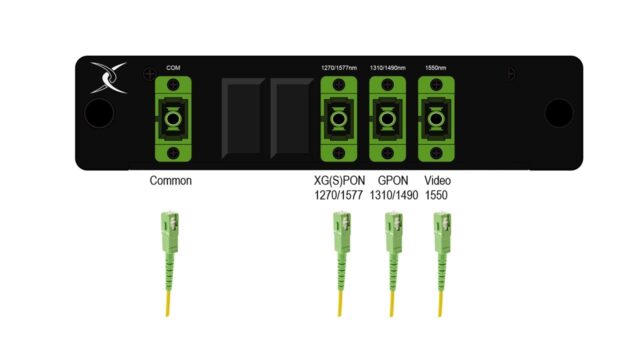
Coexistence Filter for RF Overlay, GPON and XG(S)PON
The Maxcom Coexistence mux allows systems to offer a combination of services over single fiber FTTx archetectures. These external muxes support a combination of E or GPON, XG(S)PON, and RF Overlay. 1550, 1270, 1577, 1310, 1490 nm
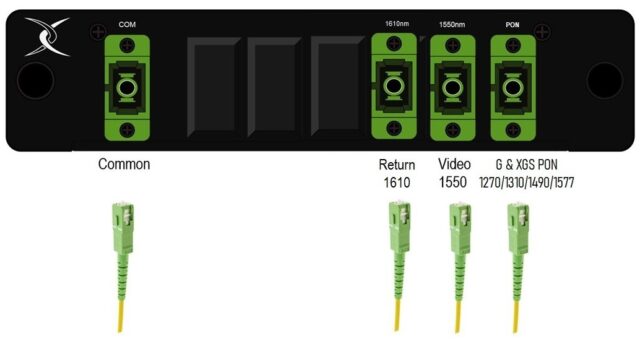
Coexistence Filter for RFoG, RF Overlay, Combo GPON and XG(S)PON
The Maxcom Coexistence mux allows systems to offer a combination of services over single fiber FTTx archetectures. These external muxes support a combination of E or GPON, XG(S)PON, RF Overlays, RFoG forward and return paths. 1550, 1610, 1270, 1577, 1310, 1490 nm
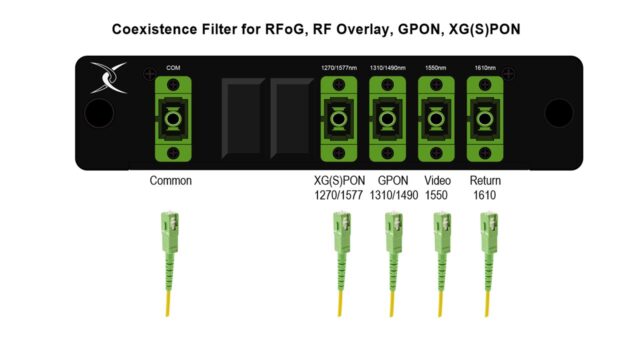
Coexistence Filter for RFoG, RF Overlay, GPON, XG(S)PON
The Maxcom Coexistence mux allows systems to offer a combination of services over single fiber FTTx archetectures. These external muxes support a combination of E or GPON, XG(S)PON, RF Overlays, RFoG forward and return paths. 1550, 1610, 1270, 1577, 1310, 1490 nm

EDFA for CATV, Multiple Output, 1550nm
The EDFA has multiple output ports, used in FTTx distribution networks. This optical amplifier is packaged in a 19” rack mount housing. The EDFA can be ordered with 4, 8, 16, 32, 64 and 128 output ports and various output powers ranging from +16.5 to 23 dBm per port.

EDFA with built in PON WDM ports
Multiple Output Port EDFA with PON Ports. Each output port for the optical amplifier has built-in high-performance CWDM PON port to conveniently connect with an OLT. Each of the output optical ports will multiplex wavelengths from the PON ports supporting G-PON, XGS-PON, NG-PON* (25G or 50G) *25G/50G PON wavelengths of 1286, 1342 & 1358nm for (ITU-T G.9804.3 Amd.1 for wavelength Option 3) from an external OLT Available in 4, 8, 16, 32, and 64 outputs. +15 to +23 dBm output power per port.
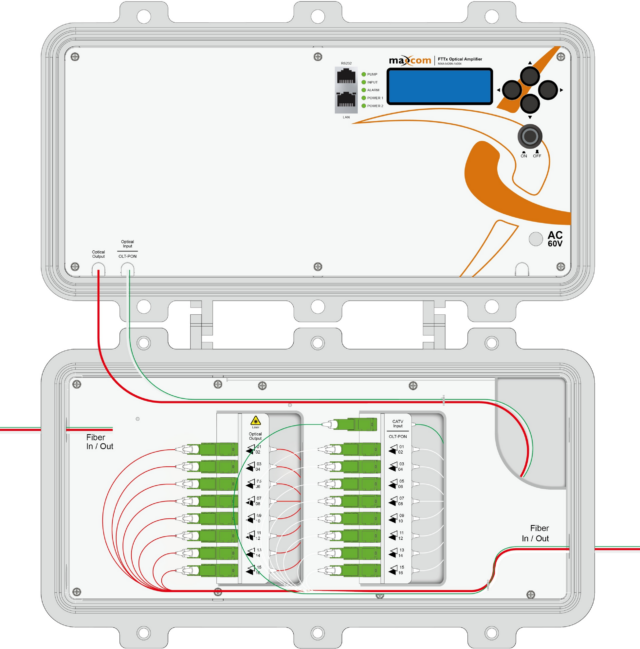
Outdoor EDFA with optional built in PON WDM ports
Multiple Output Port Outdoor EDFA with PON Ports. Each output port for the optical amplifier has built-in PON Port. Each of the output optical ports will multiplex wavelengths from the PON ports supporting G-PON, XGS-PON, NG-PON* (25G or 50G) *25G/50G PON wavelengths of 1286, 1342 & 1358nm for (ITU-T G.9804.3 Amd.1 for wavelength Option 3) from an external OLT, Available in 4, 8, or 16 outputs. +17 or +20 dBm output power per port.